
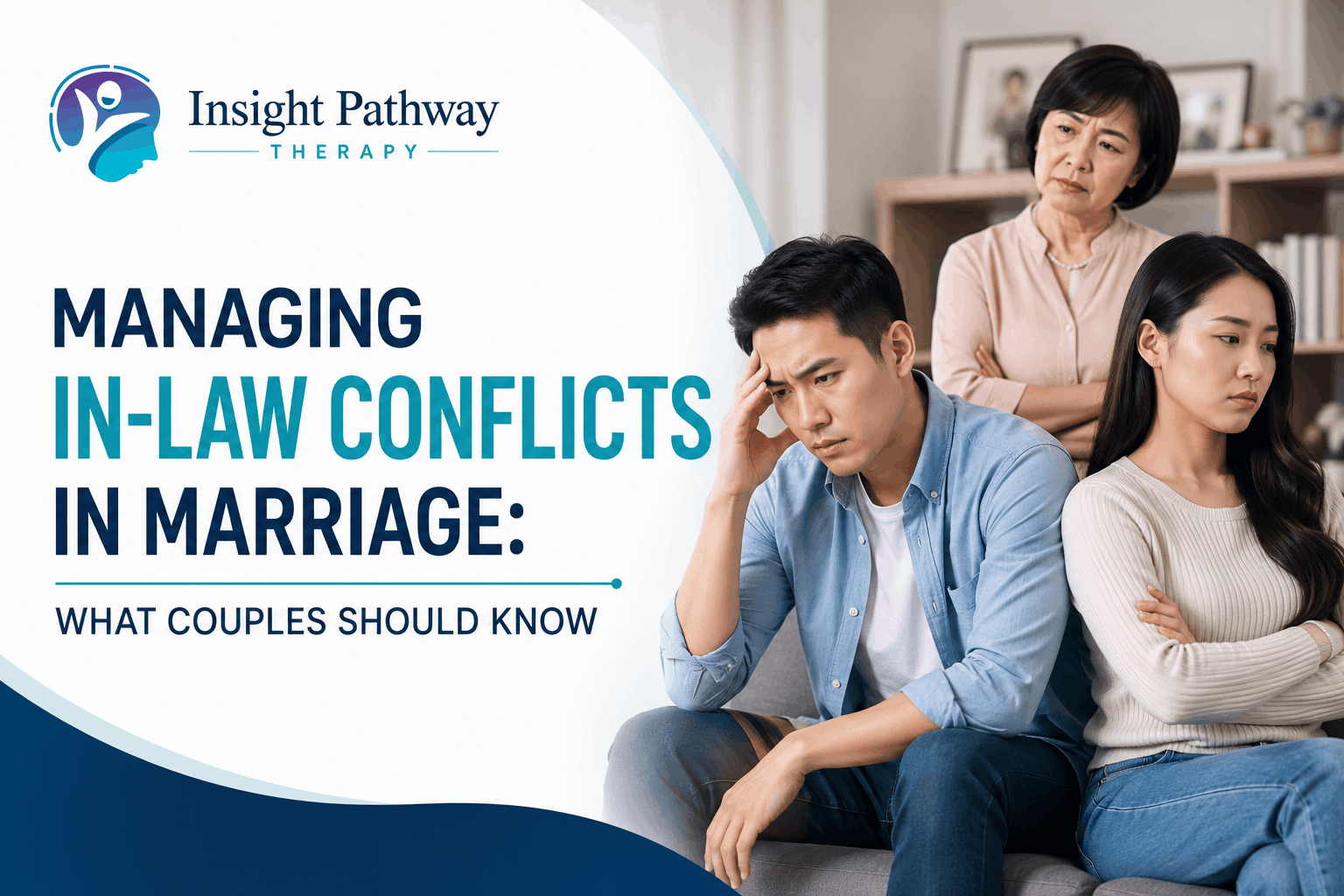
Conflict With In-Laws in Marriage: How Couples Can Set Healthy Boundaries
Getting married does not just bring two people together. It often brings two families into closer contact as well.
For many couples, this transition is manageable. For others, conflict with in-laws can become one of the more stressful parts of married life.
Unsolicited advice, different expectations, boundary-pushing behaviour, disagreements about parenting, or unresolved family tensions can affect both individual well-being and the relationship between spouses.
The good news is that couples can learn to navigate these challenges without every disagreement becoming a larger family conflict.
This blog explores why conflict with in-laws arises, the signs that in-law tension may be affecting your marriage, and practical ways of setting boundaries with in-laws while maintaining respectful family relationships.
Why In-Law Conflicts Arise in Marriage
Conflict with in-laws can develop for many different reasons. Emotional attachment, generational differences, cultural expectations, different parenting approaches, and unclear family roles can all contribute to tension.
Some parents may find it difficult to adjust when their adult child begins making independent decisions with their spouse. Other disagreements may arise because family members have different expectations about visits, finances, celebrations, parenting, privacy, or communication.
Sometimes, the issue is not one particular comment or disagreement but a repeated pattern that leaves one or both partners feeling criticised, dismissed, controlled, or emotionally drained.
Understanding where the tension comes from can make it easier for couples to decide which issues need to be addressed and which differences may simply need to be accepted.
Signs That Conflict With In-Laws Is Hurting Your Marriage
In-law tension does not always stay between the extended family and one partner. Over time, it can begin affecting the couple's own relationship.
Some signs that the situation may need attention include:
- You and your spouse frequently argue after family visits or interactions.
- One partner feels caught between their family and their spouse.
- You feel anxious, judged, criticised, or disrespected around your in-laws.
- Your decisions about parenting, finances, lifestyle, or household matters are repeatedly questioned.
- One partner feels that the other does not provide enough support during difficult family interactions.
- Family disagreements are creating emotional distance or resentment between you and your spouse.
- You avoid important conversations with your partner because you are worried about creating another conflict.
These situations do not automatically mean that your in-laws are the problem. They may indicate that the couple needs clearer communication, expectations, and boundaries around extended-family involvement.
When to Set Boundaries With In-Laws
Boundaries are not about being harsh, disrespectful, or cutting family members out of your life.
Setting boundaries with in-laws means establishing reasonable limits around areas of your life that belong primarily to you and your spouse.
These boundaries might involve:
- How often family members visit
- Whether visits need to be arranged in advance
- How parenting decisions are handled
- What personal information is shared with extended family
- How disagreements are discussed
- What kind of communication feels respectful
- How much involvement family members have in major decisions
For example, if family members regularly arrive without notice, a couple might agree that visits should be arranged in advance.
If extended family members frequently comment on parenting choices, the couple might decide together which advice they are comfortable receiving and which decisions they want to make independently.
Clear boundaries can reduce uncertainty and help prevent resentment from building over time.
How to Set Boundaries With In-Laws Step by Step
Step 1: Talk to Your Partner First
Before addressing your in-laws, talk privately with your spouse.
Discuss what is happening, how it affects each of you, and what you would like to change.
Try to focus on specific behaviours rather than describing someone's entire personality.
Instead of saying, “Your mother is overbearing,” you might say, “I feel uncomfortable when our parenting decisions are repeatedly questioned.”
This makes it easier to have a constructive conversation.
Step 2: Define What You Need
Be specific about the boundary.
Rather than saying, “We need more respect,” identify what respectful behaviour would look like.
For example:
“I would like us to make parenting decisions together before discussing them with our families.”
Or:
“I would feel more comfortable if visits were arranged in advance.”
Specific boundaries are easier to communicate and maintain than vague expectations.
Step 3: Communicate Clearly and Kindly
When a boundary needs to be communicated to an in-law, try to remain calm and respectful.
For example:
“We would love to spend time together, but it would help us if you could give us some notice before visiting.”
Or:
“We appreciate your advice. We’ll take some time to think about it and decide what works best for our family.”
You do not need to be aggressive to be assertive.
Step 4: Follow Through Consistently
Setting boundaries is only part of the process. Consistency is also important.
If a boundary is repeatedly ignored, the couple may need to calmly reinforce it and decide what action they will take if the pattern continues.
A boundary is most useful when you understand what you can realistically control and are prepared to follow through with your own actions.
Remember: Boundaries can protect relationships rather than automatically damaging them.
Conflict Resolution With In-Laws: What Works
Even when boundaries are communicated clearly, disagreements may continue.
Conflict resolution becomes particularly important when extended-family tensions begin affecting the marriage.
Start by managing your own reactions. Responding to difficult comments with immediate anger may escalate the situation rather than resolve it.
Use clear, assertive communication to explain what is happening and what you need.
Address recurring problems before resentment becomes overwhelming. You do not need to respond to every comment, but repeated behaviours that significantly affect your relationship may need to be discussed.
It is also important for couples to distinguish between disagreements that require action and differences that may simply need acceptance.
You cannot control another person's opinions or reactions. You can, however, decide how you and your partner communicate, what boundaries you establish, and how much influence a particular conflict has on your relationship.
How to Deal With Difficult In-Laws Without Hurting Your Marriage
Some family relationships may remain challenging despite your best efforts.
In these situations, the goal may not be to change your in-laws. Instead, focus on reducing the impact of ongoing conflict on your marriage.
Support Your Spouse Without Forcing Them to Choose
A partner may feel deeply conflicted when they experience tension between their spouse and their family.
Instead of demanding that they choose one side, try to acknowledge the complexity of the situation.
You might say:
“I know this is difficult for you too. Let’s work out how we can handle it together.”
Create Shared Boundaries
Couples can discuss which areas of their relationship they want to keep private and which family interactions they are comfortable with.
Shared boundaries can help reduce confusion and prevent recurring disagreements.
Maintain Individual Family Relationships Where Appropriate
Being married does not necessarily mean that both partners need to have exactly the same relationship with each other's families.
One partner may spend more time with their own family while the other prefers less contact.
What matters is that these differences are discussed openly and do not undermine the couple's shared agreements.
Limit Contact When Necessary
If interactions repeatedly become harmful, hostile, or emotionally overwhelming, reducing contact or creating more distance may sometimes be appropriate.
The level of contact should be considered carefully, particularly where there are cultural, practical, or caregiving responsibilities involved.
Find a Healthy Place to Process Difficult Emotions
It can be helpful to speak with a trusted person or mental health professional rather than repeatedly discussing family conflicts in ways that increase resentment.
A therapist can provide a neutral space to explore the situation and identify more constructive ways to communicate.
When to Seek Professional Support
If ongoing in-law conflict is causing frequent arguments, emotional distance, resentment, or significant stress within the marriage, professional support may be worth considering.
Couples counselling can help partners:
- Improve communication with each other
- Identify recurring patterns of conflict
- Develop healthier boundary-setting skills
- Practise assertive communication
- Understand each other's family dynamics
- Reduce blame and defensiveness
- Work together on practical solutions
Family counselling may also be appropriate in some situations, depending on the people involved and the nature of the conflict.
Professional support does not require every family member to agree. Sometimes, helping the couple communicate more effectively with each other can be an important first step.
Final Thoughts: Protecting Your Marriage While Navigating Family Conflict
Conflict with in-laws can be complicated because it often involves family history, loyalty, cultural expectations, emotional attachment, and different ideas about what family relationships should look like.
The goal does not have to be choosing between your spouse and your family.
Instead, couples can work toward clearer communication, reasonable boundaries, mutual support, and a healthier way of managing differences.
Setting boundaries with in-laws does not mean rejecting family. It means creating clarity about what belongs within the couple's relationship and what can appropriately involve extended family.
With patience, teamwork, and professional support when needed, couples can learn to navigate family conflict without allowing it to define their marriage.